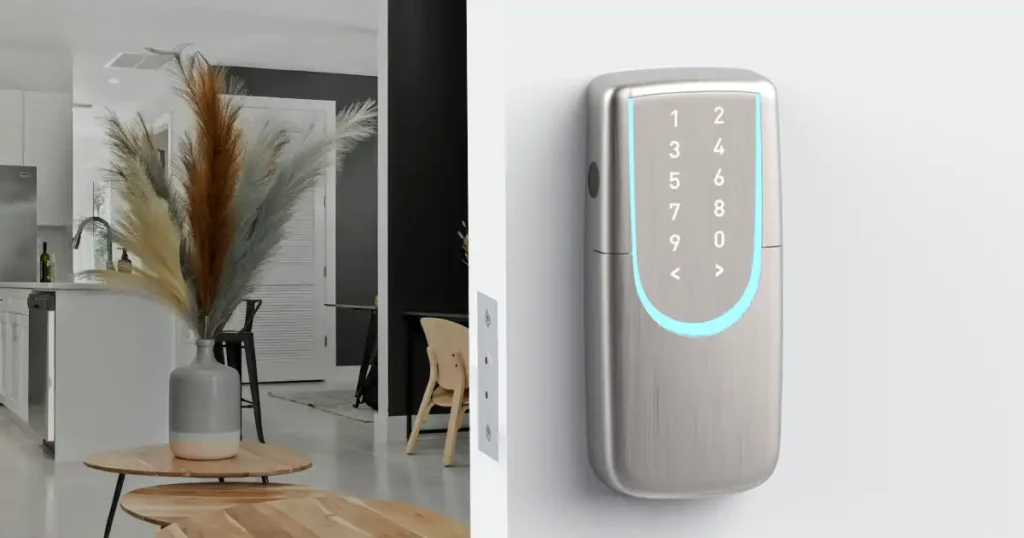
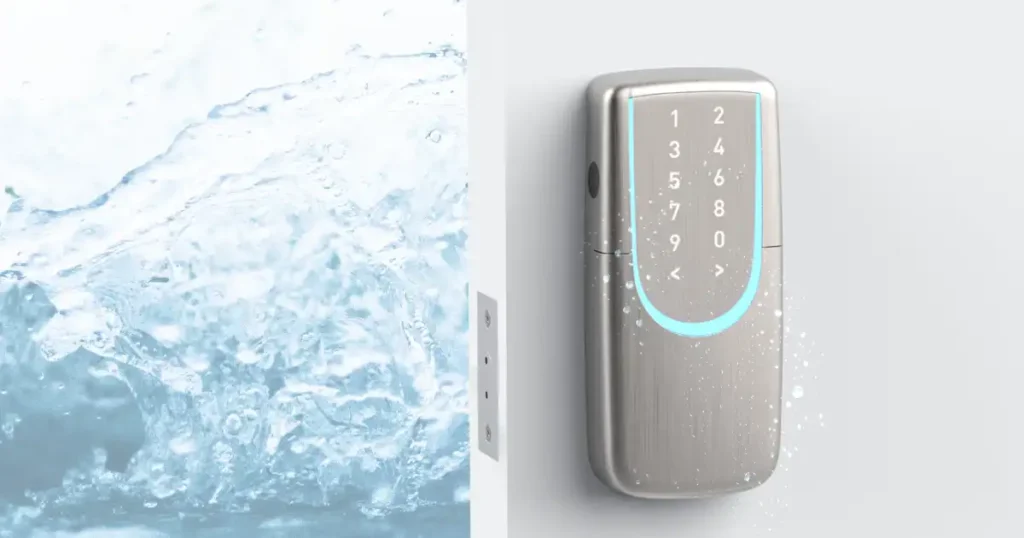
“Can a smart lock get wet?” is one of the most common questions people ask before purchasing a smart lock.
Smart locks contain electronic components, batteries, sensors, and internal wiring. In addition to unlocking methods and smart features, it is also important to consider whether the installation location will be directly exposed to rain or moisture.
Before deciding whether a smart lock is suitable for your door, it is important to understand one thing: waterproof and splash-resistant are not the same.
What’s the Difference Between Waterproof and Splash-Resistant?
In everyday use, the term “waterproof” is often used broadly to describe a product’s ability to resist water. However, the actual level of protection can vary depending on the amount of water, direction of exposure, and duration.
Here is a simple comparison:
| Protection Type | Description |
|---|---|
| Splash-Resistant | Designed to handle small amounts of water droplets or occasional splashes |
| Rain-Resistant | Provides protection against rain under specific conditions or directions |
| Waterproof | Typically requires specific testing conditions or a defined protection rating |
| Water Immersion Protection | Designed to withstand immersion in water and should not be confused with general splash resistance |
A product described as “splash-resistant” is therefore not necessarily designed for prolonged exposure to heavy rain or immersion in water.
If a product has an IP protection rating, its suitability should be evaluated according to the manufacturer’s specified rating and testing conditions rather than relying solely on the term “waterproof.”
Why Does Rain Exposure Matter for Smart Locks?
Smart locks are different from purely mechanical locks.
The exterior and interior units typically communicate through internal wiring and electronic components, while the lock may also contain circuit boards, batteries, and other electronic modules.
Even when a smart lock is designed to handle everyday splashes, prolonged exposure to heavy rain or standing water should still be avoided.
Extra attention should be given to locations such as:
- Outdoor doors without overhead protection
- Entrances exposed to wind-driven rain
- Coastal or high-humidity environments
- Locations where the lock may be directly exposed to water spray
Is an Awning Enough for Smart Lock Installation?
An awning or roof provides useful protection, but it is not the only factor to consider.
The direction of rainfall, wind conditions, and the actual position of the lock should also be evaluated.
For example, even when an entrance has an awning, strong winds may still blow rain directly onto the lock. Long-term exposure to moisture may also affect electronic components.
Before purchasing a smart lock, consider:
Door Type → Installation Location → Direct Rain Exposure → Level of Shelter → Suitable Operating Environment
Evaluating the actual installation environment gives you a much clearer answer than simply asking whether a smart lock is “waterproof.”
How Are SGUDA Smart Locks Designed for Everyday Environments?
SGUDA smart locks are designed with the everyday needs of residential and commercial environments in mind.
Splash resistance does not mean that a smart lock should be continuously exposed to heavy rain or submerged in water.
If you plan to install a smart lock outdoors, in an unsheltered location, or somewhere frequently exposed to heavy rain, we recommend confirming the installation environment and product suitability before purchase and installation.
You can also provide photos of your door and installation location, allowing us to help evaluate whether the door type and environment are suitable.
Beyond Residential Use: Smart Access for Hospitality
For vacation rentals, short-term rentals, and hospitality businesses, the installation environment is only one consideration. Guest access permissions and remote management can also play an important role when choosing a smart lock.
Depending on the product and system requirements, SGUDA smart locks can also be evaluated for integration with a PMS (Property Management System), extending smart access control to self check-in and hospitality management applications.
If you are considering smart access for a vacation rental, hotel, or PMS integration project, share your use case and system requirements with us to discuss potential SGUDA smart access solutions and collaboration opportunities.
Simplify Your Operations
with SGUDA
Want to find out whether your PMS can integrate with SGUDA?
API availability, system architecture, and integration requirements vary between PMS platforms. Actual integration options need to be evaluated based on each individual system.
Contact us via LINE and tell us about your current PMS and requirements. We’ll discuss potential system integration and collaboration options that fit your needs.